
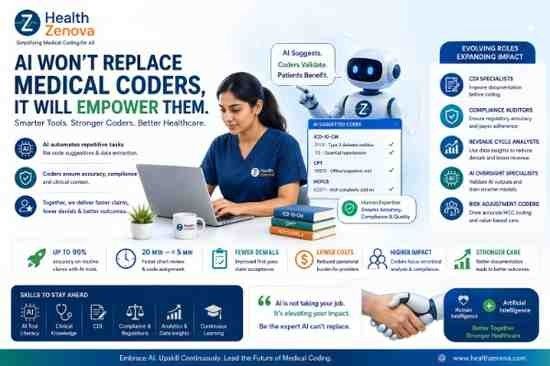
Artificial intelligence is no longer a distant concept in healthcare it is actively reshaping how hospitals bill, how claims are filed, and how diagnoses are documented. For the thousands of professionals who work as medical coders, the question is no longer whether AI will affect their jobs. The real question is: will it replace them, or will it make them more powerful than ever?
The answer, backed by evidence from healthcare systems already deploying AI tools, points firmly toward the latter but with a critical condition: coders must be willing to evolve.
Quick summary
- AI automates repetitive coding tasks such as ICD-10 and CPT code suggestions, reducing administrative burden on coders.
- Medical coders are not being replaced, they are transitioning into auditors, compliance specialists, and AI oversight roles.
- AI coding tools can achieve up to 95% accuracy on routine claims but still struggle with complex, multi-condition cases requiring human judgment.
- The demand for medically literate professionals who can validate AI outputs is growing, not shrinking.
- Coders who upskill in AI tool management, CDI, and compliance will be the most valuable professionals in healthcare billing.
- Facilities using AI-assisted coding report faster claim turnaround, fewer denials, and lower operational costs, making AI an ally, not a rival.
What AI is actually doing in medical coding today
Modern AI systems in medical coding primarily use natural language processing (NLP) to read clinical notes, physician documentation, and discharge summaries. From these documents, they automatically suggest relevant ICD-10-CM, CPT, and HCPCS codes a process that previously required a trained coder to manually interpret dense medical language and cross-reference code libraries.
Tools such as computer-assisted coding (CAC) platforms are already embedded in major health systems. They scan incoming documentation in real time and propose codes before a human coder reviews the chart. This dramatically speeds up the coding workflow what once took 20 minutes per chart can now be reviewed in under five.
For routine, single-condition encounters such as a straightforward outpatient visit or a common prescription, AI performs remarkably well. The challenge arises with complex inpatient cases, rare diagnoses, or situations where the coder must interpret a physician’s ambiguous intent and this is precisely where human expertise remains irreplaceable.
The case against full replacement
Critics of AI-driven automation often point to accuracy as a concern and rightly so. While AI tools perform impressively on high-volume, predictable coding scenarios, they are not infallible. Errors in medical coding carry real consequences: claim denials, compliance violations, potential fraud flags, and revenue loss for healthcare providers.
Medical coding also involves regulatory compliance with standards set by CMS, AHA, and the AMA. These rules change annually, ICD-10 updates alone can introduce hundreds of new and revised codes each cycle. AI models must be continuously retrained to reflect these updates, and even then, edge cases require a professional who understands not just the codes, but the clinical context behind them.
There is also the matter of payer-specific rules. Insurance carriers often maintain their own coding requirements that go beyond standard code sets. An experienced coder navigating a multi-payer environment brings institutional knowledge that no AI, as of today, can fully replicate.
How the role of medical coders is evolving
Rather than eliminating coders, AI is shifting what they do. The most significant transformation is the move from manual code selection to AI auditing. Coders increasingly serve as validators reviewing AI suggestions, correcting errors, resolving coding conflicts, and flagging cases that require physician queries.
Emerging roles for medical coders in the AI era include:
- Clinical Documentation Improvement (CDI) specialists — working directly with physicians to improve the accuracy and completeness of medical records before coding occurs.
- Coding compliance auditors — reviewing AI-generated codes for accuracy, payer adherence, and regulatory compliance across large claim volumes.
- Revenue cycle analysts — using AI-driven dashboards to identify denial patterns and develop strategies to improve first-pass claim rates.
- AI training specialists — helping vendors improve model performance by annotating incorrect outputs and providing expert feedback loops.
- Risk adjustment coders — especially critical in value-based care and Medicare Advantage plans, where accurate HCC coding directly affects reimbursement.
The skills medical coders need to stay ahead
The coders who will thrive in an AI-augmented healthcare environment are those who treat AI literacy as a professional skill not a threat. Understanding how machine learning models interpret clinical text, where they commonly fail, and how to efficiently review their outputs puts a coder in an indispensable position.
Credentialing remains critically important. Certifications from the AAPC (CPC, COC, CIC) and AHIMA (CCS, RHIT, RHIA) continue to signal clinical knowledge depth that AI cannot substitute. Coders who pair these credentials with training in CDI, healthcare analytics, or revenue cycle management will have the broadest career opportunities.
Equally important is staying current with coding updates, payer policy changes, and emerging documentation standards disciplines that require ongoing professional development, not just a one-time certification.
What the data tells us about job outlook
The U.S. Bureau of Labor Statistics projects steady demand for health information technologists and medical records specialists through the end of the decade. Healthcare is generating more data than ever from telehealth visits and remote monitoring devices to genomic testing and all of it requires accurate documentation and coding.
Healthcare organizations that have adopted AI coding tools consistently report that they did not reduce headcount, they redeployed staff. Coders previously bogged down in routine volume now handle exception management, compliance review, and quality assurance. The net effect is a more skilled, more strategically positioned workforce.
It is also worth noting that physician shortages and expanding patient populations mean the volume of healthcare encounters and thus the coding demand continues to grow. AI may handle more individual codes per encounter, but the number of encounters requiring oversight is also rising.
The verdict: upgrade, not replace
AI is not coming for medical coders. It is coming for the most repetitive, time-consuming, and error-prone parts of their job freeing them to focus on tasks that actually require clinical intelligence, regulatory expertise, and human judgment.
The coders who will be displaced are those who resist adaptation. The coders who will lead the next decade of healthcare revenue cycles are those who see AI as a productivity multiplier a tool that makes them faster, more accurate, and capable of working at a higher strategic level than ever before.
At HealthZenova, we believe that simplifying medical coding for all means embracing every tool that makes coders more effective, including artificial intelligence. The future of this profession is not a battle between humans and machines. It is a partnership.