
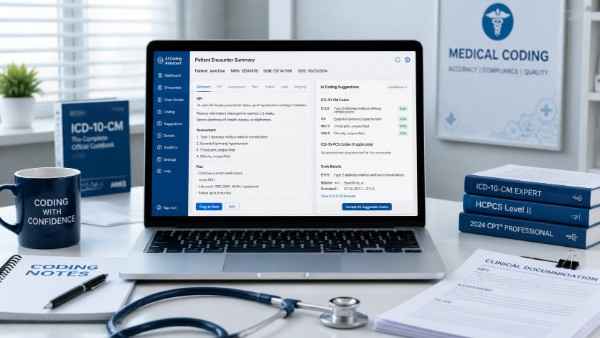
AI-assisted coding tools are changing how medical coders work, but learning them well still takes practice, not just software access.
Key Takeaways for Learning AI-Assisted Coding Tools
- Learn the basics of medical coding before using AI-assisted tools.
- Practice with real cases to understand how 3M, Optum360, and Epic suggest codes.
- Compare AI recommendations with documentation and coding rules.
- Build a habit of reviewing, correcting, and validating every suggestion.
- Avoid overreliance on automation, because coder judgment is still essential.
- Use feedback from audits and senior coders to improve accuracy and speed.
Why these tools matter
AI-assisted coding tools help coders move faster, reduce manual effort, and flag documentation gaps before claims go out. In healthcare, that matters because coding accuracy affects compliance, reimbursement, and denial management, so even a small error can have a real business impact. Tools like 3M’s coding platforms, Optum360 EncoderPro, and Epic-integrated AI suggestions are designed to support coders rather than replace them, which means the user still needs strong coding judgment. That is why learning these tools is less about memorizing buttons and more about understanding how the AI interprets clinical documentation.
Start with coding fundamentals
Before you touch the software, make sure your ICD-10-CM, CPT, HCPCS, and documentation interpretation skills are solid. AI tools can suggest codes, but they work best when the coder already understands anatomy, procedures, modifiers, medical necessity, and payer rules. If your coding foundation is weak, the tool can look “smart” while still leading you toward bad decisions. A strong coder uses AI as a second set of eyes, not as an autopilot system.
Learn one platform deeply
Do not try to master 3M, Optum360, and Epic all at once. Start with the platform your organization uses most, then learn its workflow from documentation review to code confirmation. 3M-style CAC systems are commonly used to suggest codes and improve CDI, while Optum360 tools are known for coding support, search, and crosswalk-style reference functions. Epic environments may present AI-driven coding suggestions inside the EHR workflow, so you also need to understand where the suggestion appears, how to accept or reject it, and how that decision affects downstream billing. Once you know one platform well, transferring to another becomes much easier because the core logic is similar.
Practice with real cases
The fastest way to learn AI-assisted coding tools is through live-style practice using de-identified charts, sample encounters, and feedback from senior coders. Read the clinical note first, predict the likely code family, and then compare your answer with the AI recommendation. If the system suggests something different, ask why: Was a diagnosis unsupported? Was the procedure incomplete? Was a modifier missing? This type of comparison trains you to think critically and prevents blind trust in automation. Over time, patterns emerge, and you will recognize which documentation phrases consistently trigger certain suggestions.
Build a review routine
A useful habit is to create a three-step review process: check the chart, check the AI suggestion, and check the payer/coding rule. That routine keeps you compliant and makes errors easier to catch before they become denials. It also helps when the AI recommendation is technically correct but not appropriate because of context, sequencing, or incomplete documentation. In practice, the best coders treat AI output like a draft that still needs professional validation. This mindset is especially important in hospital settings where coding complexity is higher and audit exposure is greater.
Use feedback to improve
AI-assisted systems improve when coders interact with them consistently, but coders improve too. If your Epic workflow includes accept/reject actions, take them seriously and learn why the AI was right or wrong. If 3M or Optum360 flags documentation gaps, track those gaps and discuss them with CDI or clinical teams when appropriate. Keep a log of common mistakes, such as unsupported diagnoses, missed laterality, unclear procedure wording, or overcoding. That log becomes your personal training guide and shortens the learning curve.
Common mistakes to avoid
One common mistake is assuming the software knows the full clinical context. Another is focusing on speed before accuracy, which can create denial risk and compliance problems. Coders also sometimes trust the first suggestion without checking alternate code options, exclusions, or documentation specificity. A final mistake is learning features in isolation without understanding how they fit into the revenue cycle workflow. The goal is not just to use the tool; the goal is to code more accurately, more efficiently, and more confidently.
Conclusion
Learning AI-assisted coding tools is really about combining coding knowledge with technology fluency. Start with one platform, practice on real cases, review every AI suggestion critically, and use feedback to sharpen both speed and accuracy. For 3M, Optum360, and Epic, the coder’s judgment still matters most, because the best results come when human expertise guides the AI, not the other way around.