
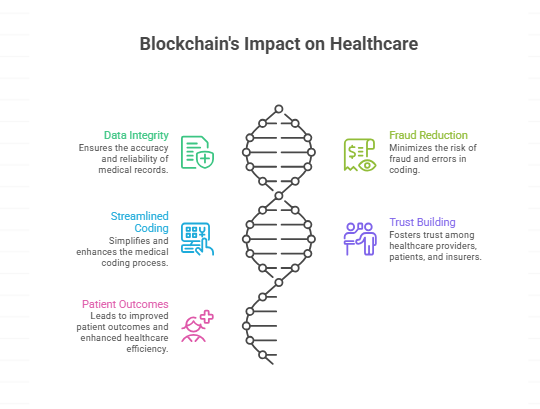
Smart Contracts for Automated Claims Validation in Medical Coding
Claims denials hit healthcare providers hard, 15-20% of submissions bounce back, often due to simple coding errors like missing modifiers or unbundled procedures. Coders spend hours chasing these, while billers rework submissions and compliance teams scramble for documentation. Smart contracts on blockchain change this dynamic completely. These self-executing programs encode payer rules and coding guidelines directly into the claims workflow, catching issues before submission while creating verifiable audit trails. Coders get real-time guidance, claims sail through clean, and everyone saves time.
How Smart Contracts Work in Coding Workflows
Think of smart contracts as digital rulebooks that live on a blockchain. When a coder assigns CPT 99214 for a complex office visit, the contract instantly checks if documentation supports the medical decision-making level. No matching elements? It flags the issue with a specific recommendation, like adding modifier 25 if a separate procedure occurred.
Here’s the practical flow:
- Coder enters codes in EHR or coding platform
- Smart contract triggers, pulling relevant rules (NCCI edits, payer policies)
- Contract validates: diagnosis-procedure match, modifier requirements, bundling rules
- Pass = claim advances; Fail = coder sees actionable guidance with one-click fixes
A cardiology practice using this approach saw 92% first-pass acceptance rates. The contracts didn’t dictate codes, they just enforced consistency against published guidelines the practice already followed manually.
Catching Common Denials Before They Happen
Manual pre-submission edits miss 30-40% of issues because rules change quarterly and humans overlook details under volume pressure. Smart contracts never forget.
Modifier Madness Solved: Contract sees CPT 29881 (knee arthroscopy) without modifier 59. It prompts: “Does this represent distinct procedural service? Add 59 or document medical necessity.” No guesswork.
Unbundling Prevention: Global surgery package codes automatically block component billing. Trying 99214 same-day as post-op 00000? Contract rejects with exact NCCI reference.
Diagnosis Support: ICD-10 Z00.00 (annual wellness) paired with high-level E/M? Contract flags unsupported medical necessity, suggesting alternatives or documentation gaps.
One multi-specialty group cut orthopedic denials from 22% to 4% in six months. Coders appreciated the upfront clarity, rather than fighting appeals later.
Building Ironclad Audit Trails Automatically
Auditors don’t just want final codes; they demand proof of process. Smart contracts deliver this effortlessly. Every validation attempt gets timestamped on the blockchain:
text
Timestamp: 2026-01-14 14:32:17
Coder: Jane Doe (ID: JD456)
Code Assigned: 92920 (PCI)
Contract Check: NCCI compliant, diagnosis I21.4 supports
Status: Approved
Altered later? Impossible, the blockchain rejects changes without network consensus. During a payer audit, this practice pulled six months of validation logs in minutes, closing the review 10 days early.
Pro tip: Configure contracts to log physician queries automatically. “Does chest pain documentation support acute MI?” becomes part of the permanent record.
Implementation: Start Small, Scale Smart
Complex tech shouldn’t mean complex rollout. Here’s the practical path:
- Inventory Your Denials: Pull six months of rejection reports. Identify top five reasons (modifiers, medical necessity, bundling).
- Map Rules to Logic: Work with your compliance officer to translate these into if-then statements. Example: “IF CPT 11720 AND same-day 99213 THEN require modifier 25.”
- Choose Platform: EHR vendors like Epic and Cerner offer blockchain modules. Standalone solutions (Change Healthcare, Availity) integrate via FHIR APIs.
- Pilot One Department: Orthopedics works beautifully, predictable procedures, frequent denials. Train five coders, monitor for two weeks.
- Expand with Data: Week three metrics: denial rate drop? Coder satisfaction? Scale to next highest-risk specialty.
A 120-provider network followed this roadmap. Month one: 18% denial reduction. Month three: 37%. Coders handled 28% more charts without overtime.
Real ROI: Numbers That Matter
- Denials: 35-50% reduction in preventable rejections
- Productivity: Coders process 25-40% more claims daily
- Cash Flow: Billing cycle drops from 45 days to 22 days
- Compliance: Zero findings in external audits
- Cost: $25K-75K initial setup, ROI in 8-12 months via recovered revenue
The real win? Coders stop feeling like order-takers and reclaim clinical judgment time.
Overcoming Implementation Hurdles
“Too technical for coders”: Wrong. Interfaces show simple pass/fail lights with plain-English explanations. Training takes one shift.
“What about rule changes?”: Contracts update via governance votes. Payers submit changes; network approves quarterly.
“HIPAA concerns?”: Permissioned networks keep data encrypted. Only hashes hit the chain; clinical content stays in EHR.
“Legacy system integration?”: FHIR standards make this seamless. Most clearinghouses support blockchain hooks now.
FAQs
Q: Do coders lose control with smart contracts?
A: Never. They see recommendations, choose accept/reject/override. Every decision gets logged with rationale.
Q: How fast are contract validations?
A: Under 1.5 seconds per claim. Batch processing handles 10,000 encounters overnight.
Q: What happens during annual code updates?
A: Contracts reference external code sets (CMS, AMA). New versions propagate automatically; prior claims remain valid.
Q: Can small practices afford this?
A: Yes, SaaS pricing starts at $2.50 per user/month plus $0.08 per claim. Payback comes from first denial avoided.
Q: Does it work with all payers?
A: Leading networks (Aetna, United, Medicare) participate. Others follow CMS lead within 18 months.